
- Offers
- Service providers
- Knowledge base
- Tools
- Arena
- Contact
- Partners
EN
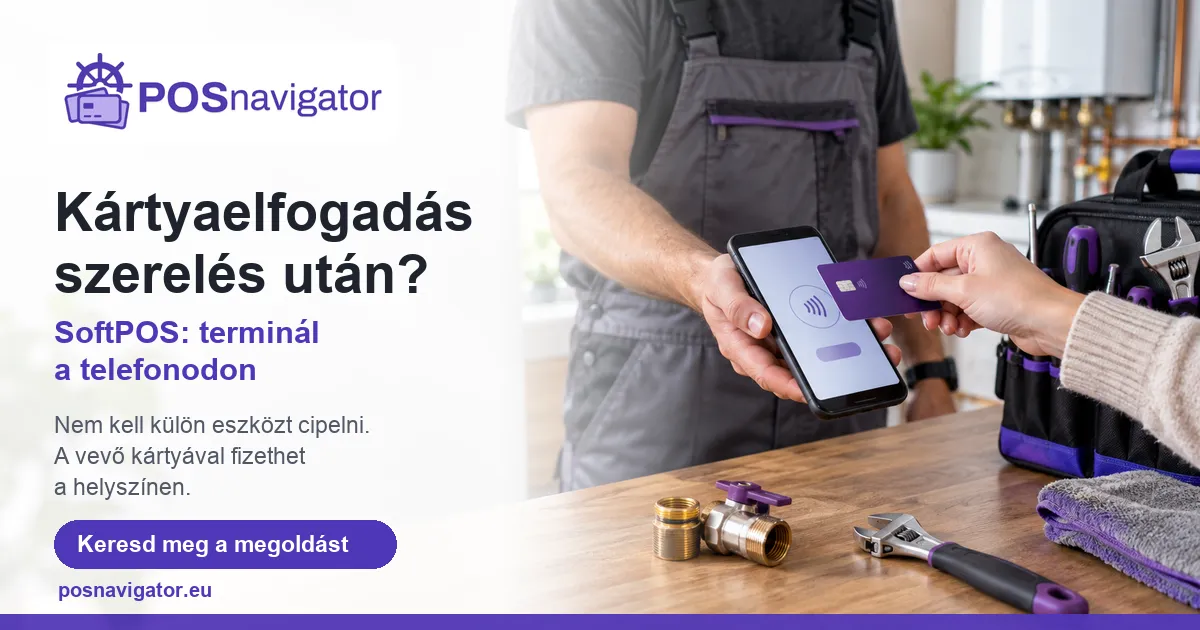
Short answer: if you work on-site as a gas, plumbing, electrical, HVAC or locksmith professional, the most practical first card acceptance option is often SoftPOS: a terminal app installed on your own smartphone. You do not need to carry another device in the toolbox, you do not need to worry about a separate terminal battery, and a classic terminal rental fee does not automatically weigh on quieter months. Exact fees always depend on the offer, but as a starting point SoftPOS is a strong fit for mobile trades.
The flow is simple: after the job, you enter the amount in the phone app, the customer taps their card or mobile wallet, and the receipt can go by email or SMS. To compare options quickly, use the preconfigured POSnavigator search box at the end of the article, or start from the SoftPOS offers.
On-site work is rarely a tidy office checkout. You have tools to pack, another address to reach, and the final amount may change during the job. A phone-based acceptance flow means one less device to manage.
Fewer devices: your phone is already with you; no separate reader or terminal needs to be carried.
Less battery risk: there is no second terminal battery to run flat at the wrong moment.
More flexible fixed cost: many mobile acceptance setups avoid classic terminal rental, which matters when on-site work varies month by month.
Convenient receipts: digital receipts by email or SMS can replace paper rolls if the provider supports them.
Less cash friction: the customer does not need to find an ATM when the final price is higher than expected.
For more background, read our SoftPOS in Hungary guide and our comparison of whether a POS terminal, mobile card reader or SoftPOS fits a given use case better.
A gas technician completes a two-year boiler maintenance visit. During the work, it turns out that a small part also needs to be replaced, so the final amount is HUF 25,000. The customer did not withdraw extra cash in advance; they only expected the standard maintenance fee.
With SoftPOS, the payment does not need to become a problem. The technician packs away the tools, opens the payment app on their smartphone, enters HUF 25,000, the customer taps their card, and the receipt is sent immediately by SMS or email. The extra part replacement is handled on the spot instead of turning into a follow-up transfer or a trip to an ATM.
SoftPOS is not the only possible answer. It is especially strong if you work alone, do not need paper receipts, your phone is compatible with the provider's app, and most payments are on-site service amounts.
A mobile card reader or classic POS terminal may be better if several employees use the same setup, you accept cards all day, you need printed receipts, or you do not want to use your own phone as the payment device. With higher regular turnover, total cost should also be recalculated, because the lowest starting cost is not always the best long-term choice.
In POSnavigator, compare offers based on how your business actually works, not on provider advertising. For mobile tradespeople, these questions matter most:
Monthly card turnover: if it varies, start with a conservative estimate.
Average job value: an HUF 8,000 and an HUF 50,000 transaction may lead to different fee outcomes.
Need for a separate device: if not, start with SoftPOS; if yes, compare mobile readers as well.
Monthly fixed fee, terminal rental or account requirement: these can matter a lot at lower volumes.
Settlement speed: cash flow matters for small businesses.
Accepted cards and wallets: Visa, Mastercard, Apple Pay and Google Pay support are basic expectations for many customers.
If you are introducing card acceptance as a mobile tradesperson, do not start with “which provider is best”. Start with the payment situation. If customers pay on-site, after the work, often for a variable amount, begin with SoftPOS and mobile card acceptance.
The preconfigured POSnavigator search box at the end of this article models exactly this situation. Adjust monthly card turnover, average transaction value and operating needs, then compare total cost, fixed monthly fees, contract terms and settlement. If you are unsure, this related article is also useful: you may not need a POS terminal, but you do need electronic payment.
Not necessarily. SoftPOS means your compatible smartphone acts as the payment terminal. Exact device and operating system requirements depend on the provider.
This is one of the strongest reasons for on-site card acceptance. If a part replacement or extra repair changes the final amount, the customer can pay by card immediately.
Yes, most solutions need mobile data or Wi-Fi. For on-site work, plan with stable mobile internet and a charged phone.
Usually yes, as a digital receipt by email or SMS. If you need paper receipts, a mobile card reader or printer-equipped terminal may be more practical.
No. For solo professionals with variable on-site work, it is often the most convenient starting point. For teams, higher volume or paper-receipt needs, a mobile card reader or classic POS terminal may be better. POSnavigator helps compare this with your own numbers.
Weekly summary of the best POS terminal offers
We handle your data confidentially. Details in the privacy policy.