
- Offers
- Service providers
- Knowledge base
- Tools
- Arena
- Contact
- Partners
EN
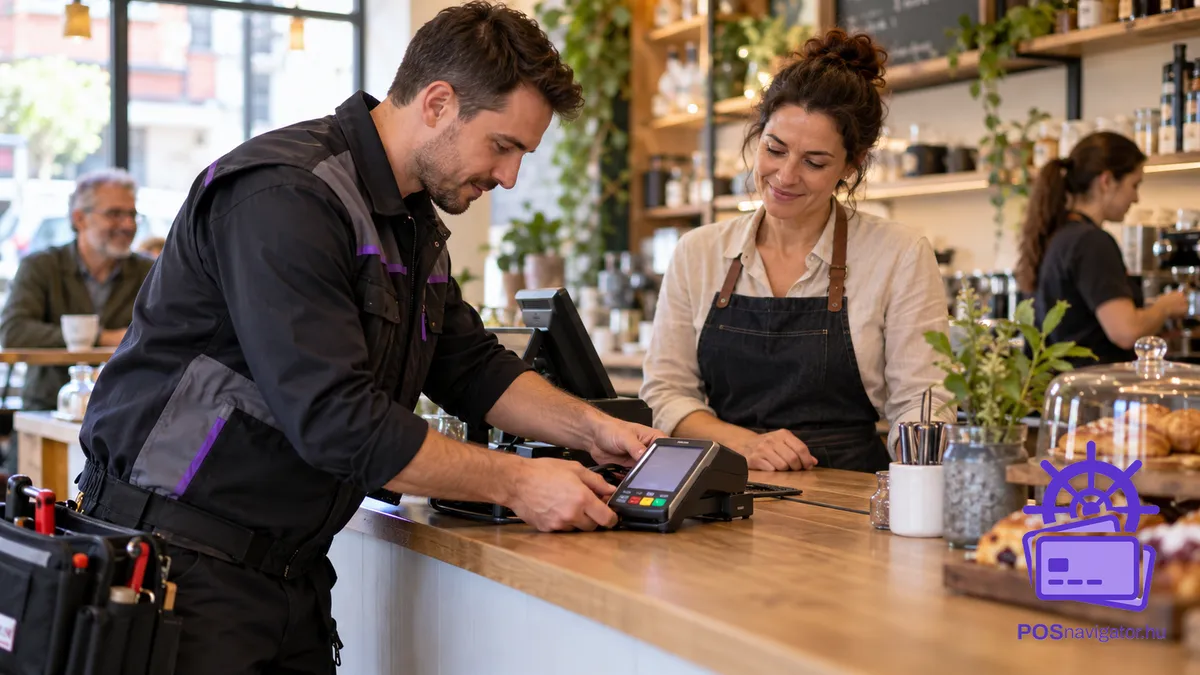
Choosing a POS terminal may look like a simple pricing decision. The device should look good on the counter, payments should be fast, and the offer should be slightly cheaper than the next one.
But card acceptance is not decoration. Payment is a critical step in your sales process. If the terminal stops working during Friday evening peak hours, on a busy terrace, after a booked service or at the end of an on-site job, the main question is no longer whether you saved a little on monthly fees. The real question is whether you can still take payments.
So before choosing a POS terminal, ask this:
What happens if the payment setup fails because of the provider's fault?
For a merchant, three things matter most:
Most offers talk about the first two points. The third often becomes visible only when there is already a problem.
Outages can come from device failure, connectivity issues, SIM problems, cash register integration, provider-side incidents, software updates or settlement disruption. For the merchant, the result is the same: the customer is ready to pay, but the payment route does not work.
If there is no backup, the merchant may lose the sale, damage the customer experience and spend valuable staff time on troubleshooting.
If you are still choosing between the basic payment types, start with our comparison of POS terminals, SoftPOS and payment gateways, then read the guide on how to choose a payment service provider. For the contractual angle, our article on hidden costs in card acceptance is also relevant.
Ask for clear answers before you sign.
1. Is there a service level or availability commitment?
There is a big difference between "we will try to help quickly" and a written process with support channels, response times and recovery steps.
2. How can you report incidents?
By phone, email, app or ticketing system? Is support available in the evening, on weekends or during holidays? For restaurants, hotels, events or other peak-time businesses, weekday-only support may not be enough.
3. How quickly will the provider diagnose and restore service?
Ask separately about remote diagnostics, replacement terminals and realistic replacement times for rural or multi-site operations.
4. Who decides whether the incident is provider-side?
The contract should explain what counts as a provider-side fault and what may be treated as an internet, cash register, card network or merchant-side issue.
5. Is there compensation, fee credit or reimbursement for provider-side outages?
Do not stop at "we will review it". Ask when fee credits or compensation may apply, what evidence is required, whether there is a cap and whether lost revenue is excluded.
6. Is there a workaround, not only after-the-fact compensation?
Fast restoration may be more valuable than a disputed damages claim weeks later. Options may include immediate remote diagnostics, a committed replacement-terminal timeframe, a spare device, a second terminal, payment links, QR-based instant payments or, as an additional fallback, an automatically activated SoftPOS app.
Lost revenue is difficult to prove after the event.
If your terminal is down for two hours, the provider may see a support ticket. For you, it may mean lunch rush, booked appointments, tourist traffic or customers who simply walk away.
To claim damages, it is usually not enough to say "I would have had sales". You may need to document the incident, the duration, the provider's responsibility, the expected turnover, the causal link and the steps you took to reduce the loss.
That is why the better business question is:
How do we prevent a terminal outage from becoming lost revenue?
The first answer is not an after-the-fact dispute. It is the provider's operating process: a fast support channel, immediate remote diagnostics, clear escalation, a committed replacement timeframe and a pre-agreed temporary payment route.
Before signing, clarify who is reachable immediately, what support hours apply, how long remote diagnostics take, when a technician or replacement device is sent, how provider-side fault is established, what temporary payment route can be used until restoration, and whether fee credit or compensation applies if the provider misses the committed restoration process.
In short: we did not find a Hungarian rule that generally and automatically requires a payment provider to compensate a merchant's full lost revenue when POS acceptance fails because of a provider-side issue.
This does not mean merchants have no legal options. It means they should not assume automatic compensation.
The practical legal picture has three layers.
Payment services rules cover payment transactions, non-execution, defective execution, unauthorised transactions and provider liability. These rules matter if a payment transaction was initiated and then failed or was handled incorrectly. They are not the same as a customer being unable to start a payment at all and leaving without buying.
Civil law damages may become relevant if the provider breaches the contract. In principle, lost profit can be part of damages, but the merchant must usually prove breach, provider-side fault or responsibility, causation, amount of loss, foreseeability and mitigation.
Commercial rules require affected merchants to ensure electronic payment availability for consumers. This makes outages a business and compliance risk for the merchant, which is another reason to design fast maintenance, replacement and temporary payment routes in advance.
If payment acceptance stops, first restore operations. Then make sure you have evidence.
Document:
Without this, compensation discussions become much harder.
A POS terminal is not just a device. Payment is the last critical step of the sale. If it fails, you have a revenue risk and a customer experience problem, not just a technical issue.
Before signing, do not look only at monthly fees, transaction fees and device design. Check support, maintenance and replacement processes, temporary payment options, compensation rules and who carries the risk when provider-side failure interrupts payment acceptance.
The best POS choice is not necessarily the one that looks a little cheaper on paper. It is the one that helps you keep selling when something goes wrong.
CTA: Compare card acceptance options on POSnavigator, and look beyond fees: check contract terms, support quality and backup payment routes.
This article is a merchant decision-support summary, not legal advice. For legal or compensation questions, always check your own contract, provider terms and, where needed, consult a legal professional.
Do not assume an automatic, general right to full compensation. The actual claim may depend on the contract, the cause of the outage, the available evidence and the provable amount of loss. This is why compensation, fee-credit and liability-limitation clauses should be clear before signing.
No. "Fast help" is a useful promise, but merchants need specifics: support channel, response time, ticket number, replacement timeframe, weekend support, temporary payment route and a written process.
A good commitment is concrete: immediate incident reporting, response time, remote diagnostics, technician or replacement-device process, and a temporary payment route while the physical terminal is being restored.
Report the incident immediately, ask for a ticket number, document the screen or error message, note the exact times, and activate the temporary payment route if you have one. Then summarize the incident to the provider in writing.
Not necessarily. Alongside fees, check support quality, replacement processes, temporary payment options, contractual liability and how much revenue you risk during a longer outage.
Weekly summary of the best POS terminal offers
We handle your data confidentially. Details in the privacy policy.