
- Offers
- Service providers
- Knowledge base
- Tools
- Arena
- Contact
- Partners
EN
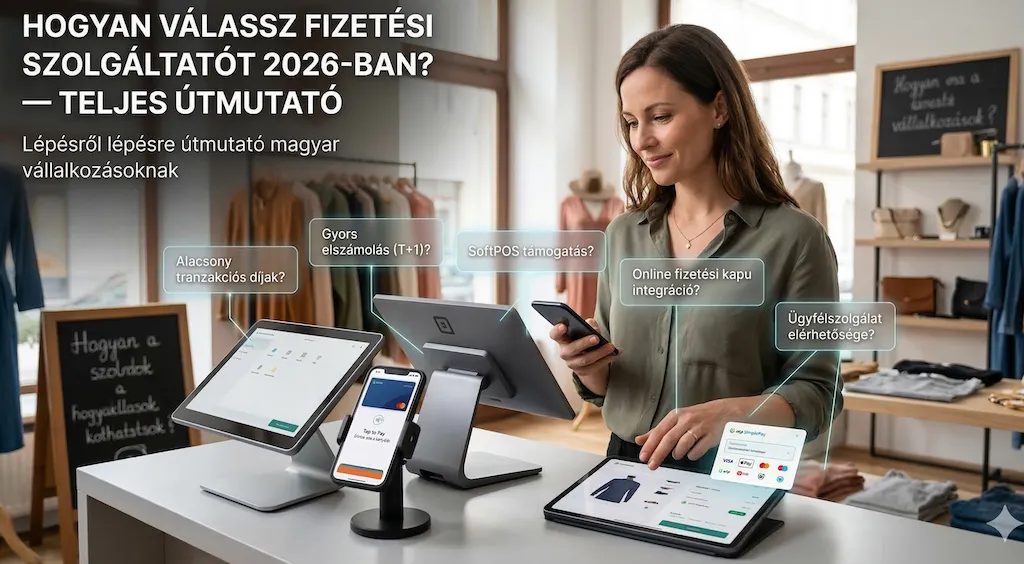
If you're setting up card acceptance for your business or looking to switch providers, one of the biggest decisions you'll face is: which payment service provider should you work with? In Hungary, around 30 providers offer POS terminals, SoftPOS solutions, or online payment gateways — and there can be significant differences between their offers. In this guide, we'll walk you through what to look for, step by step, so you can make the best decision possible.
Many business owners assume that card acceptance is essentially the same everywhere and only the price matters. That's not quite true. Your provider determines what terminals you'll use, how quickly funds arrive in your account, how transparent the fee structure is, and the level of customer support you'll get when something goes wrong.
A poorly chosen provider can lock you into months of unnecessary costs, slow payouts, or inflexible contracts. A good choice, on the other hand, simplifies your daily operations and can save you hundreds of euros per year.
Before diving into the details, it's worth understanding the main categories of providers available on the Hungarian market. Each type has its own strengths.
Traditional banks — such as OTP Bank, K&H, MBH Bank, CIB Bank, Raiffeisen — offer their own POS terminal services, typically linked to your existing bank account. Their advantage is stability and direct integration with your account. However, their disadvantage is usually the bank obligation and the longer contract period.
These companies specialize exclusively in payment processing, without traditional banking activities. Examples include Global Payments, Worldline, Fizetési Pont, Teya, and Paynance. They generally offer more flexible terms and a wider range of terminals. However, payouts go to a separate account rather than your main bank account.
Newer market players like SumUp, myPOS, Barion, SimplePay, Revolut, and viva.com often offer simpler entry: no long-term contracts, quick sign-up, and you can even buy a terminal outright. In return, transaction fees may sometimes be higher, and support isn't always available by phone.
Looking at just the monthly fee or transaction cost isn't enough — the real cost and value are determined by multiple factors together. Here are the most important ones to examine.
This is the most common starting point, and rightly so. But it's crucial to look at the entire fee structure, not just a single number:
Transaction fee: the percentage charged on your turnover (typically 0.7–2.5% in Hungary). Some providers also add a fixed per-transaction amount.
Monthly fee or terminal rental: most traditional providers charge a monthly fee for the terminal, typically ranging from EUR 8–30.
Minimum turnover fee: if you don't reach the required monthly turnover, you may pay an additional fee — especially important for seasonal businesses.
Other fees: installation, maintenance, statement fees, early termination — these can add up to significant extra costs per year.
POSnavigator's cost calculator helps you compare providers' actual costs based on your real monthly turnover, rather than just the headline rate.
The length and flexibility of the contract matter just as much as the fees. Pay attention to contract duration, termination conditions, automatic renewal clauses, and whether the provider can unilaterally change fees during the contract period.
The general rule of thumb: fintech providers offer more flexible terms, while banks tend to have stricter contracts. But this isn't universal — always read the fine print.
How quickly does the money reach your account after a card payment? This is especially important for cash-flow-sensitive businesses. In Hungary, payout times generally range from 1–3 business days, though some providers offer next-day or even same-day settlement, sometimes for an extra fee.
Consider whether you need a portable terminal, a countertop device, SoftPOS capability, cash register integration, or smart Android terminals. Not every provider offers every option, so make sure their hardware fits your business operations.
When your terminal stops working on a Saturday morning with customers waiting, support quality suddenly becomes critical. Check whether the provider offers Hungarian-language phone support, reasonable response times, replacement terminals, and weekend availability.
How fast can you get started? Aggregators like SumUp and myPOS can have you accepting cards within a day. Bank-based providers typically take longer but offer more personalized assistance.
Today's terminals need to support contactless payments (NFC), Apple Pay, Google Pay, Visa, Mastercard, and in Hungary, SZEP Card for hospitality businesses, qvik. Not every provider supports every method, so verify before committing.
Now that you know the criteria, here's a practical process to guide your decision:
Assess your needs: Consider your business type, location, expected card turnover, and required payment methods.
Narrow the field: Use POSnavigator.eu to compare providers by business type, fee structure, and terminal type.
Calculate with real numbers: Use the cost calculator to see actual monthly and annual costs based on your turnover.
Read the contract terms: Check contract length, termination conditions, minimum turnover requirements, and fee change clauses.
Get quotes and compare: Request quotes from 2–3 providers and compare them using the same criteria.
If you already have a provider but aren't satisfied, you don't have to stay forever. Consider switching if your fees have increased significantly, payouts are consistently late, support is hard to reach, your contract is expiring, or your business has outgrown its current solution.
Before switching, always check the termination conditions in your current contract to avoid surprises.
Choosing a payment service provider isn't a decision worth rushing. Fees, contract terms, payout speed, terminal selection, customer support, and onboarding speed all affect your long-term satisfaction.
The best thing you can do: research, compare, and calculate with real numbers. POSnavigator is designed to help with exactly that — compare providers, calculate costs, and find the solution that best fits your needs.
Weekly summary of the best POS terminal offers
We handle your data confidentially. Details in the privacy policy.