
- Offers
- Service providers
- Knowledge base
- Tools
- Arena
- Contact
- Partners
EN
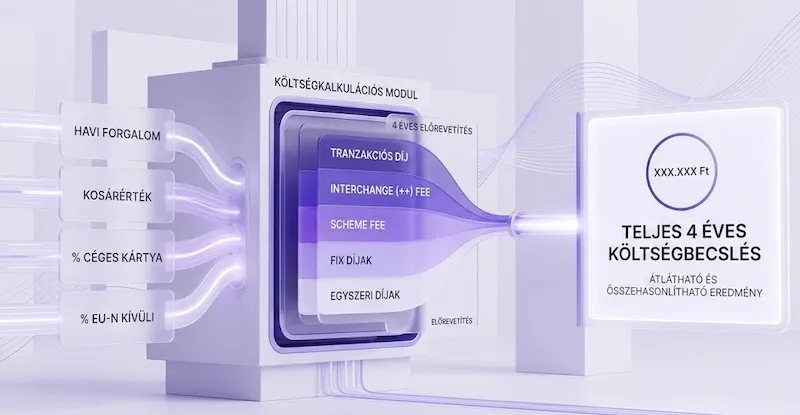
One of POS Navigator’s most important features is that it helps you compare the real costs of different card payment solutions. But how exactly does our cost calculation work? In this article, we explain the logic in a clear and accessible way.
 Why is accurate cost calculation important?
Payment providers’ fee structures are complex: there may be a fixed monthly fee, transaction fees, card scheme costs, terminal rental fees, and many other elements. Comparing these on your own is almost impossible. Our system calculates (estimates) a single, consolidated cost figure, tailored to your business data.
For the cost calculation, we ask you for the following information:
Expected monthly card turnover – How much revenue do you expect per month from card payments?
Average basket value – The amount of an average purchase. We use this to calculate the number of transactions.
Share of corporate card customers – Corporate (commercial) cards typically have higher processing costs.
Share of non-EU customers – Cards used by tourists and foreign customers can also involve different fees.
From these inputs, we calculate the monthly transaction count and take into account the market distribution of different card types. This is necessary because different card types (Visa, Mastercard, domestic or foreign, credit or debit) can carry different fees.
It’s important to note that we only estimate the market distribution of card types—and in reality it can vary significantly by merchant. For example, in a downtown café, customers may pay with foreign cards much more often; or in a car rental business, there’s a much higher chance customers will pay with more expensive credit or corporate cards.
So POS Navigator provides estimates only. Merchants with a special customer base should run their own calculations as well before making a decision.
1. Transaction fees
For most providers, this is the largest cost element. Transaction fees usually have two parts:
Percentage fee – a percentage of the purchase amount (e.g., 1.5%)
Fixed fee per transaction – a fixed amount charged for each transaction (e.g., HUF 25)
In some cases, the provider may also define a minimum or maximum transaction fee.
Our system takes both components into account and calculates the total transaction cost based on the turnover data you provide.
The interchange fee is the cost paid to the card-issuing bank for each transaction. This fee is not set by your provider, but typically by the card schemes. Some providers don’t separate this fee and include it in the transaction fee (blended pricing), while others charge it separately (interchange++ pricing).
The level of the fee depends on:
Card type (consumer, corporate, premium)
Place of issuance (EU or non-EU)
Transaction method (in-person or online purchase)
Merchant category code (MCC)
Our system considers interchange fees for more than 30 different card types and calculates based on the customer mix you provide.
Card scheme fees (scheme fees)
Visa and Mastercard also charge their own fees for processing transactions. These are usually lower than interchange fees, but in total they can still be significant. Here too, some providers include these fees in the transaction fee (blended pricing), while others charge them separately (interchange++ pricing).
The level of scheme fees can vary by payment provider, because providers pass on complex, hard-to-track costs to merchants in different ways. These fees are not always published and are often changed when scheme costs or internal calculation methods change.
If the payment provider publishes them, POS Navigator tries to calculate using the current scheme fees; otherwise, we estimate them.
Many providers charge fixed monthly fees that are independent of turnover, for example:
Availability fee
Terminal rental fee
Monitoring fee
Other recurring fees
It’s important to note that some providers rent out POS terminals (for a monthly fee), while others sell the hardware to the merchant. Also keep in mind that rental fees typically include terminal maintenance, repair, and replacement—so it’s worth considering whether buying the terminal is truly cheaper.

One-time costs that arise at contract signing or installation:
Installation fee (e.g., per POS terminal)
Contract setup fee
Terminal purchase cost (if you don’t rent)
Some providers also charge annual fees, for example a PCI DSS compliance fee or an annual maintenance fee.
Our system projects costs over a 4-year timeframe. Why 4 years?
Most contracts are for 2–4 years
One-time costs are spread out more realistically
Over the long term, the real cost difference becomes visible
A simplified formula for total cost:
Total cost = (Monthly transaction fees × 48 months) + (Monthly fixed fees × 48 months) + (Annual fees × 4 years) + One-time fees
Some providers use transparent Interchange++ pricing. This means:
They pass through the interchange fee unchanged
They also pass through the scheme fee
They show their own service fee separately
Our system can calculate accurately for these products too, taking all three cost elements into account.
You can read more about interchange++ pricing in this article: https://posnavigator.eu/hu/user/blog/hogyan-szamoljuk-a-kartyaelfogadas-koltseget
Many providers offer discounts for the first months, such as:
Free months of the monthly fee
Reduced transaction fees for an initial period
Refunds under certain conditions
Our calculation also takes these discounts into account, so the 4-year total reflects the full contract period—both the promotional and the standard pricing periods.
The POS Navigator cost calculator:
Provides a calculation tailored to your business data
Takes all fee types into account (transaction, fixed, one-time)
Calculates with interchange and scheme fees
Creates a 4-year projection
Makes different offers comparable
If you’d like to try it, start our quote request wizard and you’ll get a personalized comparison in just a few minutes!
And don’t forget: POS Navigator can only estimate costs based on statistical data. Your actual costs may differ—always review the payment provider’s offer in detail.
Weekly summary of the best POS terminal offers
We handle your data confidentially. Details in the privacy policy.