
- Offers
- Service providers
- Knowledge base
- Tools
- Arena
- Contact
- Partners
EN
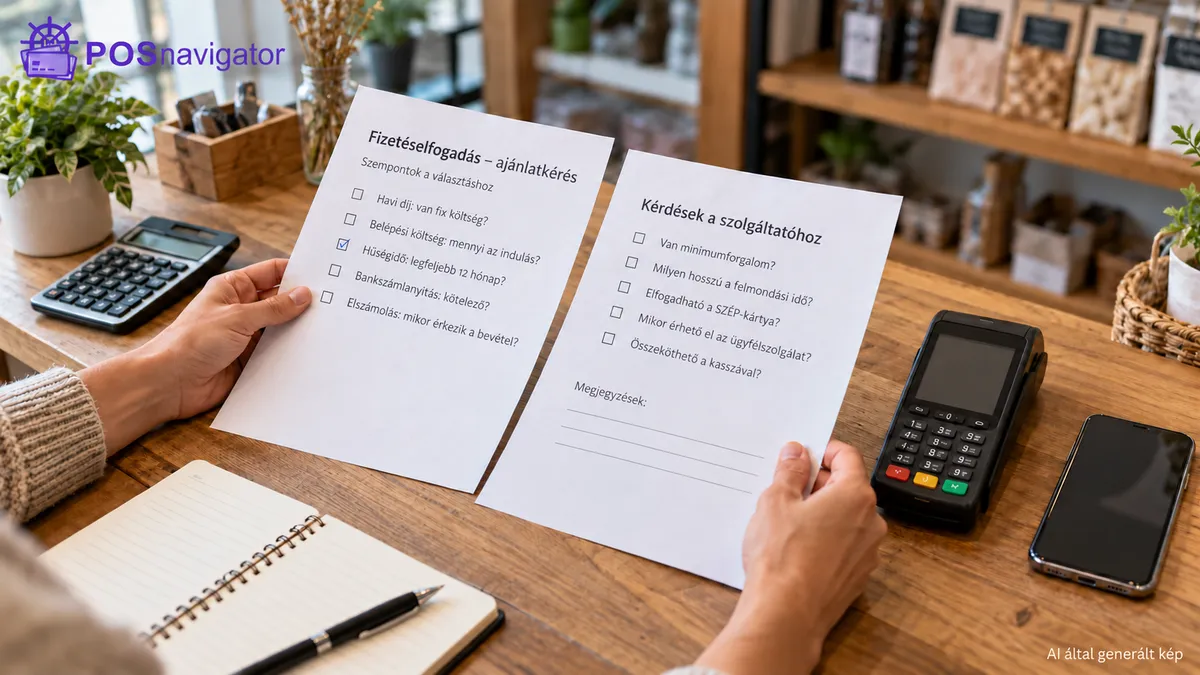
You are looking for a POS terminal or card reader, or considering a phone-based SoftPOS application. You open three offers: one promises card acceptance with no monthly fee, another advertises a lower transaction rate, and the third comes with a new bank account. You want to know which will leave more money in your business and cause fewer problems at the counter.
Start by writing down your own requirements. How much can you spend on getting started? Can you commit for a year? How important is it that takings reach your existing account quickly? These questions help you decide which offers deserve a closer look.
On POSnavigator, your own turnover and working routine are also the right starting point. The considerations below form a checklist for requesting quotes; their order is not a ranking of visitors' most popular searches.
No monthly fee can be an understandable priority for a new shop, a part-time business or unpredictable sales. But a zero monthly fee may sit alongside a device purchase, activation charge, transaction fee, minimum charge or separate payout cost. Find out exactly when each charge applies.
Ask this: “If I take no card payments next month, exactly how much will I owe?” Request total costs for an average month and a quiet one as well. At consistently higher turnover, a plan with a monthly fee and a lower transaction rate may cost less.
Consider two invented plans, purely to illustrate how the arithmetic works. Plan A has no monthly fee and charges 1.5% per transaction. Plan B costs HUF 2,000 a month plus 1.0%. We exclude other charges, taxes, device costs and differences between card types; these are not provider offers.
For your actual offers, include every applicable fee. Our guide to the hidden costs of card acceptance helps you identify charges that a prominent headline percentage can leave out.
Separate upfront spending from monthly running costs. List the purchase or rental cost, activation, delivery, installation and accessories. If you would use a SoftPOS application, check support for your exact phone model. Buying a new phone is still an upfront expense.
A rented POS terminal and a purchased device affect your cash flow differently. Ask for one total for day one and another for the first twelve months. Together, they give you a more useful view of affordability.
A maximum twelve-month commitment can be your personal search requirement. Add notice periods, automatic renewal, returning equipment and any repayment of introductory discounts to the checklist. Even an offer with no lock-in needs clear terms for ending the service.
Ask this: “If I close the business or switch providers in month eight, when does the contract end and what will my final bill be?” A concrete scenario makes it easier to get an answer you can check than simply asking whether a plan is flexible.
Distinguish keeping your existing bank from opening an additional provider account. Even if you do not have to switch banks, card takings may first be credited to an account maintained by the payment provider. Check how and at what cost the funds reach the account you use to run the business.
Request the account-opening, account-maintenance and onward-transfer terms. If you pay suppliers from another bank, include transfer frequency and costs. You can then weigh the convenience of your existing banking relationship against the pricing of another arrangement.
The time when funds appear in a provider balance and the time when you can use them from your own bank account may differ. When an offer mentions instant settlement, ask which account and which part of the process it refers to.
If weekends are your busiest time, request an example for a Friday evening sale: when can you use the proceeds, is payout automatic, and does it have a fee or minimum amount? That answer helps you plan Monday's stock order.
Provide your average payment amount as well as monthly turnover. A fixed fee per transaction carries more weight when customers make many small purchases. For illustration, a HUF 20 fixed fee equals 2% of a HUF 1,000 payment but 0.2% of a HUF 10,000 payment, before any percentage fee is added.
Also check whether domestic consumer, business and foreign cards have the same rate. Public pricing schedules can combine a percentage and a fixed amount, with rates differing by card category; the official pricing page of myPOS is one example. Request all quotes using the same turnover, average transaction value and card mix for your business.
Consider SZÉP card acceptance if your activity is eligible under the current rules and your customers would actually use it. Its importance may differ between a restaurant, accommodation provider or leisure service and an unrelated business. Confirm current eligibility with the issuer; the OTP merchant guidance addresses eligible activities and the issuer agreement separately.
For a week or two, note how often customers ask to pay with a SZÉP card. This is not a full market survey, but it gives you a firmer starting point than treating the feature as essential by default. Then ask which issuers you can contract with, what acceptance methods are available and what fees, settlement terms and setup apply. Standard bank-card acceptance does not by itself establish that SZÉP cards work in the same payment flow.
For seasonal businesses, minimum turnover, minimum charges and the option to suspend service deserve as much attention as the transaction rate. Ask which costs continue during closure and whether reactivation has a fee. For a short season, calculate the full commitment for that season. Our guide for market and Christmas fair traders explores this in more detail.
Choose up to three functions that your daily routine genuinely needs. A till connection may reduce entering the same amount twice; multi-user management may matter during shift changes; tipping deserves a practical trial in hospitality. Ask for a demonstration using your own workflow. For phone-based acceptance, our SoftPOS comparison provides further reading.
Compare support hours with your opening hours. A Monday morning reply may offer little help with a Saturday evening problem. Ask about contact channels, reporting a fault, device replacement and the options available while a problem is being resolved. A promised response time is separate from the time needed to fix or replace something.
Check the back-office work before signing too. Request a sample statement showing deductions and credits, then show it to your accountant. See whether an individual payment can be traced and how a refund works. A clear merchant portal can save manual work at month-end.
Identify the conditions you cannot compromise on. These might be keeping your bank, limiting commitment to a year and keeping upfront spending low. For the remaining features, write down what you would be willing to pay extra for. You can then judge apparently cheaper offers against the needs of your own shop.
Use the search tool embedded in this article to start comparing costs with your own turnover. Results are estimates. Check contract duration, account-opening requirements, SZÉP card acceptance and other conditions in the offer details and the provider's written confirmation. If a multi-year total cost is shown, do not treat that calculation period as a mandatory contract term or a quote for a short season.
Set monthly card turnover, average payment amount, the number of devices, POS or SoftPOS, and whether you are searching as a company or a sole trader. The calculation starts from HUF payments with domestic consumer Visa/Mastercard cards; request a calculation for your actual mix if it differs. Offers requiring a new account may also appear, so check that condition separately in the offer details.
For other payment methods or a more complex business, start with the full POSnavigator offer search.
The outcome depends on turnover and the complete fee schedule. Calculate each plan for at least a quieter and an average month, including upfront costs.
The contract determines this. Ask separately about notice, renewal, equipment return and any outstanding amounts.
Look for an offer whose terms allow it. Also check whether you need an additional provider account and how takings reach your existing bank account from there.
Eligibility, issuer contracts and technical acceptance must be checked separately. Include this requirement when requesting a quote.
Source checks and POSnavigator entity data: 22 October 2026. Numerical examples are illustrative calculations, not current provider prices.
Weekly summary of the best POS terminal offers
We handle your data confidentially. Details in the privacy policy.