
- Offers
- Service providers
- Knowledge base
- Tools
- Arena
- Contact
- Partners
EN
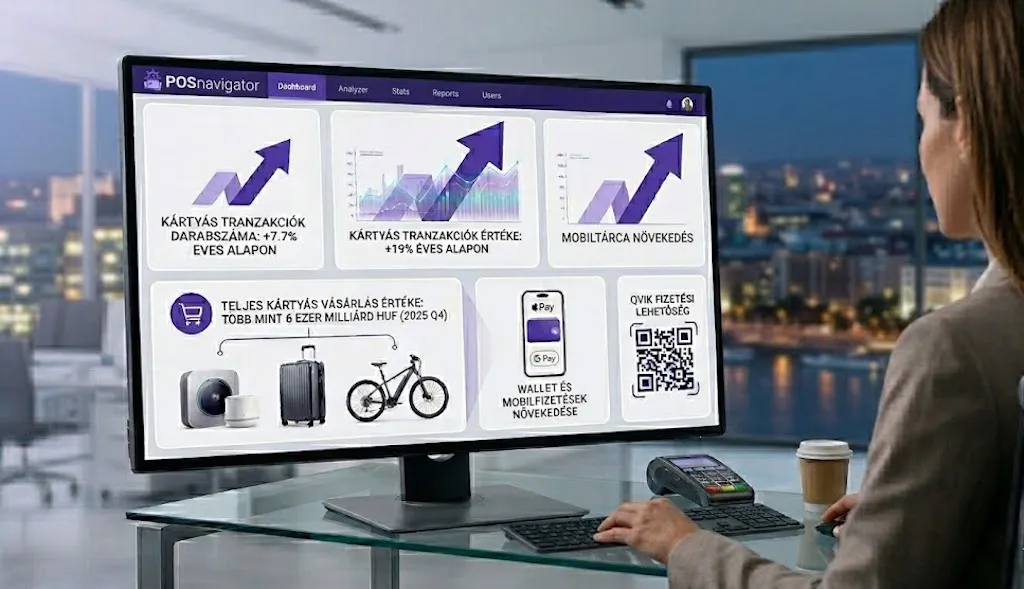
Hungarian shoppers are not only paying by card more often; they are moving higher-value purchases into electronic payment channels. According to the latest MNB payment statistics release, published on 16 March 2026, the number of purchases made with cards issued by Hungarian payment service providers grew by 7.7% year-on-year in Q4 2025, while their value increased by 19%. In that quarter, card purchases exceeded HUF 6 trillion.
For merchants, this is not just good news. More card and digital payment volume can also mean higher acceptance costs, more pressure on checkout quality and a stronger need to choose the right POS, SoftPOS or online payment gateway setup.
The previous Q3 2025 MNB release showed the same direction: transaction count grew by 6.7%, while value increased by 17.5%. The latest 19% figure is therefore not an isolated data point, but part of a wider payment trend.
The MNB release published on 16 March 2026 contains three numbers that matter especially for merchants:
The gap between transaction growth and value growth is the key message. If transaction count grows by 7.7%, but value grows by 19%, the average value of digital payments is also increasing. This means more higher-ticket purchases are moving to card and digital payment channels.
This matters most when the merchant's main acceptance cost is charged as a percentage of turnover. In that case, it is not enough to look at how many transactions you have; the total HUF value flowing through the acquiring contract also matters.
The MNB has published its Payment Systems Report every year since 2014, tracking long-term changes in domestic payments. The current 19% growth in card purchase value should therefore not be read in isolation. Over the last decade, Hungary has moved from building electronic payment infrastructure to a market where electronic payment is a normal customer expectation.
According to MNB's 2025 communication, the share of electronic payments increased in physical retail, online retail and bill payments. Card-based mobile wallet services are now used by a broad customer base: more than a quarter of payment cards have already been registered in a mobile wallet, and more than a quarter of card purchases were made with them.
The next 10 years will therefore not be about whether customers want to pay digitally. They already do. The real question is whether the merchant's payment setup is fast, cost-efficient, mobile-friendly and well matched to each sales channel.
Hungarian merchants using online cash registers have had to provide some form of electronic payment option since 2021, but the market has already moved beyond minimum compliance. Customers no longer ask whether they can pay electronically; they expect payment to be fast, familiar and reliable.
This can mean a traditional POS terminal, SoftPOS, an online payment gateway, or an instant-payment-based qvik solution. The question is no longer whether a business should accept digital payments, but which channel best fits its operations and cost structure.
Recent market reports suggest that mobile payment value grew by nearly 40% year-on-year. Visa's Hungarian country manager also told Forbes that, based on MNB data, mobile payment transaction count increased by nearly 30%, while value grew by 40%. This is an important trend, but for physical card acceptance it no longer means the same merchant task as it did a few years ago.
In physical stores, Apple Pay and Google Pay are part of modern contactless card acceptance. If a terminal accepts contactless Mastercard and Visa transactions, wallet payments are typically not a separate merchant switch or extra integration. In Hungary, the main question for a physical store is usually not whether phone-based card payment works, but whether the terminal, cash register connection, settlement process and pricing model work well together.
Online payments are different. Apple Pay, Google Pay, Click to Pay and saved-card payments are not supported equally strongly by every payment gateway and webshop integration. The rise of wallet payments in stores shows that customers are getting used to paying quickly from their phone without typing card details. They will increasingly expect the same experience in mobile webshop checkout.
The rise of mobile payment habits also supports SoftPOS application solutions. For mobile service providers, market sellers, couriers, taxis and occasional sales, a phone-based acceptance setup can be a better first step than a traditional terminal. But this is no longer mainly an Apple Pay / Google Pay acceptance question; it is a device, cost and operating model decision.
According to the MNB's Q3 data, card acquiring revenues grew by 8.1% year-on-year, and the Q4 release showed 8.7% growth. This does not mean every merchant's fee increased by that amount, but it does show that acquiring revenue moves with digital payment volume.
Merchants should therefore look beyond the headline transaction percentage. At minimum, it is worth checking:
These details matter because a seemingly low percentage fee can become a meaningful amount when average basket value rises. Hidden card acceptance costs often become visible only after volume starts to grow.
In the Forbes/Visa interview, the cited consumer data said that 44% of Hungarians abandon an online purchase if the payment process is too long. This matters especially now that wallet payment has become natural in physical stores: poor mobile checkout is not just a technical issue, it is lost revenue.
For a webshop, choosing a payment provider is therefore not only about comparing percentage fees. At least these questions matter:
We covered this in more detail in our guide to online payments for webshops.
According to the MNB Q3 release, the number of qvik acceptance locations grew by 5.2% in one quarter, and the value of qvik QR, NFC and link payments more than doubled. Q4 was even stronger: the number of qvik QR, NFC or Link payments more than doubled again in one quarter, while their value more than tripled.
qvik is interesting for merchants because it is based on instant payments and can be a cheaper alternative in certain situations. At the same time, it does not replace cards in every buying situation. Cards remain strong for tourists, international customers, familiar in-store payment and many online payment flows.
The better decision is usually not card or qvik. It is which payment method to use in which channel, and at what cost.
Do not look only at total turnover. Break it down by payment method, channel, average basket value and card type. If your digital payment share is growing, your pricing is percentage-based and many transactions have higher basket values, fee optimisation can pay back quickly.
Monthly fees, terminal rental, transaction fees, additional fees, settlement timing and contractual lock-ins all matter together. POSnavigator compares estimated total cost over four years because small monthly or percentage differences can become meaningful over time.
In physical stores, wallet payment is now essentially part of contactless card acceptance. In a webshop, however, go through the payment process on a phone and mobile network. Check whether the customer must type card details, whether Apple Pay / Google Pay is available, how fast authorisation is and what happens after a failed payment. If the process is slow, uncertain or hard to understand, it is not just a convenience issue; it is a conversion loss.
POS terminals, SoftPOS, online payment gateways, payment links and qvik are strong in different situations. A restaurant, a convenience store, a taxi, a beauty salon and a webshop have different payment profiles, so the optimal provider and pricing model will not be the same.
If your card or online payment volume increased over the last year, it is worth recalculating whether your current acquiring contract is still competitive. On POSnavigator, you can compare POS terminal, SoftPOS and online payment gateway offers available in Hungary and see which solution fits your turnover based on estimated four-year total cost.
No. This is an aggregate national MNB figure for Q4 2025. A specific merchant's growth can differ significantly depending on industry, location, online presence, customer base and payment mix.
Because it suggests that average digital payment value is also increasing. If a merchant pays percentage-based fees, higher basket values can mean higher acquiring costs in forint terms.
In some cases it can complement or partially replace card payments, but not everywhere. Cards remain strong for international customers, familiar in-store payment and many online checkout flows. qvik is better seen as an additional option and negotiating lever, not an automatic replacement.
Usually this is not the main decision point. In modern Hungarian contactless terminal acceptance, wallet-based card payment is part of the normal card acceptance flow. For online payments, however, it is worth checking separately whether the payment gateway and webshop integration support Apple Pay, Google Pay, Click to Pay or saved-card fast checkout.
SoftPOS can be a good choice when the merchant needs only a small number of acceptance points, operates in mobile or occasional sales situations, or wants to accept cards quickly with low hardware cost. A dedicated POS terminal may still be better for high-volume stores.
At least once a year, and whenever turnover has increased significantly, average basket value has changed, a new channel has launched or the provider announces fee changes.
Weekly summary of the best POS terminal offers
We handle your data confidentially. Details in the privacy policy.