
- Offers
- Service providers
- Knowledge base
- Tools
- Arena
- Contact
- Partners
EN
If you're looking for a POS terminal for your business in Hungary, you'll quickly discover that dozens of providers are competing for your attention. Banks, independent fintech companies, and international payment processors — each with different pricing, different conditions, and different strengths.
In this article, we present 10 POS terminal providers that are actively operating in the Hungarian market in 2026. We objectively summarize what each one offers and what to watch out for when choosing and present you the expected cost of using them.
If you need a fast decision point, do not look only at which provider advertises the lowest fee. The important question is the total cost for your own turnover. POSnavigator compares monthly fees, transaction fees, setup costs, contract terms and estimated 4-year cost together.
Fast route by business type: if you want offers for a specific use case, start with POS offers for small shops, hospitality POS comparison, mobile card acceptance for taxis and mobile services, or SoftPOS offers.
Lowest calculated small-shop cost: in the Small Shop Arena model updated on 2026.06.22, Raiffeisen POS 3 ranked first among publicly priced, non-test-bank offers, followed by SUMUP's POSnavigator featured offer and UniCredit's promotional POS terminal offer for new customers. Mollie dropped out of the filtered list and Viva.com became more expensive in this model.
For starting without a monthly fee: SumUp and myPOS can be good entry points for low-volume or seasonal merchants, but at higher turnover their percentage fee may not produce the lowest total cost.
For bank-independent acceptance: fintech or independent providers can be useful when you need quick onboarding, online application and more flexible contract terms.
For restaurants and hospitality: tipping, SZEP card acceptance, portable terminals and settlement speed may matter more than the monthly fee alone.
For webshops: look for a provider that can also support payment gateway, pay-by-link or future omnichannel acceptance.
In short: no-monthly-fee solutions are often convenient at low turnover, while bank-backed or interchange++ offers can become cheaper at higher turnover. Recalculate the ranking with your own data in the POSnavigator calculator.
Merchants use the phrase virtual POS terminal in different ways. Some mean phone-based in-person card acceptance, usually SoftPOS or Tap to Pay. Others mean a webshop VPOS or online payment gateway. For classic in-store card acceptance, a physical POS terminal or card reader is still the standard choice, but for mobile, seasonal or early-stage businesses SoftPOS may be enough.
Fast decision: if you want to accept cards in person without extra hardware, start with SoftPOS offers. If you need payment for a webshop, use the online payment for webshops route. If you need stable counter, shop or delivery card acceptance, compare physical POS terminal offers and calculate the full cost.
There is no single best POS terminal provider for every business in Hungary. The right choice depends on your monthly card turnover, whether you need SoftPOS, whether SZÉP card acceptance matters, how quickly you need setup, and whether you prefer a bank-backed or fintech solution.
For low-volume or new businesses, fast-start fintech options with no monthly fee, such as SumUp or myPOS, can be a good starting point.
For bank-backed stability and broader service coverage, OTP Bank, K&H, MBH, CIB or Raiffeisen may be more relevant.
For fast setup, providers with simple online onboarding, fewer contract commitments or mobile card acceptance usually have an advantage.
For larger or more complex merchants, Worldline, Global Payments or Teya may stand out because of stronger integrations and business features.
So read this article as a decision map rather than a simple awards-style ranking: it shows which provider may fit which merchant situation.
Before diving into the providers, let's clarify the most important factors for comparison:
Transaction fee: the cost charged as a percentage of each payment. It can be flat (e.g., 1.95%) or interchange++ based (built on the actual interbank fee).
Monthly fee / terminal rental: some providers charge a fixed monthly cost, others don't.
Contract commitment: some require 1-2 year loyalty periods, others let you cancel anytime.
Settlement speed: how many days until the money reaches your account? This typically ranges from 1-5 business days.
Accepted card types: Visa and Mastercard are standard, but SZÉP card, health fund cards, or JCB/Amex acceptance varies.
Terminal selection: desktop, portable, SoftPOS — the right choice depends on your business type.
Keep these factors in mind as we walk through each provider. For a more detailed guide, check our article on How to Choose a Payment Service Provider.
A POS terminal or card reader with no monthly fee can be a good fit if you are just starting out, operate seasonally, have lower card turnover, or do not want fixed rental costs. In these cases, SumUp, myPOS or some mPOS packages can be useful starting points because more of the cost is tied to actual transactions.
But “no monthly fee” does not automatically mean the lowest total cost. At higher turnover, a bank-backed or interchange++ based offer may have a lower 4-year TCO even if it includes a monthly fee. So compare the full cost, not only the ease of getting started.
No setup fee is attractive because it lowers the upfront cost. It matters especially for new merchants, pop-up stores, market vendors or smaller service businesses that do not want a high one-off charge in the first month. Check whether the discount really applies to setup or whether only the first period is discounted.
Also review the terminal price, shipping cost, activation conditions, contract commitment and replacement process if the device fails. A zero-forint start can become more expensive if it comes with higher transaction fees or a longer commitment.
An independent POS provider may be useful if you do not want to open a new bank account, need faster onboarding, or prefer more flexible contract terms. Fintech providers often offer simpler online signup, a clearer entry process and more mobile workflows, which can suit small businesses, event merchants and service providers.
Bank-backed providers can still be stronger for higher turnover, SZÉP card acceptance, branch-based support or negotiated pricing. The choice should not be ideological: compare bank-backed and independent providers based on your actual turnover, operations and settlement needs.
If you need card acceptance quickly, first check whether the provider offers online contracting, digital identification, devices in stock and an instantly activated SoftPOS option. A mobile acceptance app can often get you started faster than shipping and activating a physical terminal.
Even with fast setup, ask about settlement timing, transaction limits, compliance checks and customer support channels. Fast onboarding only helps if the payout process, support and billing are predictable as well.
A well-known bank or international payment provider can add trust, but brand recognition alone does not prove that it is the cheapest or most practical option for your business. Alongside the brand, compare total cost, contract term, accepted card types, SZÉP card acceptance, terminal replacement and settlement speed.
The point of POSnavigator is to help merchants decide based on numbers and fit, not advertising or brand awareness. Recalculate the comparison with your own business data, because a small shop, restaurant, webshop and mobile service provider may each get a different best-fit offer.
OTP Bank is Hungary's largest bank and a dominant player in the card acceptance market. It provides full POS terminal services for physical stores with both desktop and portable terminals.
OTP accepts Visa and Mastercard, supports contactless payments (NFC), Apple Pay and Google Pay, as well as SZÉP cards and health fund cards. Additional features include dynamic currency conversion (DCC), tip management, and installment payments.
Best for: businesses that value the backing of a major bank, 24/7 customer support, and SZÉP card acceptance. OTP is particularly strong in hospitality and retail.
K&H is another bank-backed provider offering physical POS terminals, online payments, and unattended payment solutions. K&H accepts international cards (Mastercard, Visa), SZÉP cards, and health fund cards.
A notable advantage of K&H is JCB and Amex card acceptance, which can be important for businesses with tourist traffic. They also provide unattended terminals for vending machines or parking facilities.
Best for: merchants who want bank-backed service with broader card acceptance (JCB, Amex) or need unattended payment solutions.
MBH Bank is Hungary's second-largest banking group (formed from the merger of MKB, Takarékbank, and Budapest Bank). It offers both POS terminal and online payment (VPOS) services, and is a pioneer of Qvik instant payments in Hungary.
Through its partnership with Worldline Financial Services, MBH also offers SoftPOS solutions and multi-currency card acceptance via Teya and Worldline partnerships.
Best for: those who value an extensive branch network, are interested in Qvik payments, or need multi-currency card acceptance.
CIB Bank belongs to the Italian Intesa Sanpaolo banking group and offers POS terminal services in Hungary. It provides both physical and online payment solutions, including SZÉP card acceptance.
Best for: existing CIB customers and businesses that value the stability of an international banking group.
SumUp is one of the most popular fintech payment solutions in Europe, available in Hungary as well. Its biggest advantage is simple pricing: no monthly fees, no loyalty period, and a flat transaction fee of 1.95% for physical terminal payments.
SumUp offers compact card readers (Air, Solo, Terminal) that work via Bluetooth or built-in SIM. A SoftPOS solution (Tap to Pay on Android and iPhone) is also available, enabling card acceptance without additional hardware.
Best for: small businesses, beginners, market vendors, and service providers who value flexibility and low entry barriers.
myPOS is a European fintech provider whose key differentiator is instant settlement — after each transaction, the money is immediately available in your myPOS business account.
myPOS offers several terminal types (portable, desktop) with built-in SIM and printer. There's no loyalty period, and terminals are purchased (not rented), which means a higher upfront cost but potentially lower total cost over time.
Best for: businesses where instant access to funds is critical (e.g., daily liquidity matters) and those who prefer buying a terminal over monthly rental.
Teya (formerly Saltpay) is a European payment provider present in 16 countries, including Hungary. Teya offers not just a POS terminal but a complete business toolkit: accounting services, digital loyalty programs, website building, booking systems, and hospitality software.
Best for: hospitality businesses and service providers who want payment terminals, loyalty programs, and business software from a single provider.
Worldline is one of the world's and Europe's largest payment service providers. In Hungary, Worldline offers a wide range of physical POS terminals: standalone (desktop), mobile, and cash register-integrated models.
Worldline's strength lies in technology and enterprise solutions: from project support and terminal integration to training and maintenance. They also offer SoftPOS solutions.
Best for: higher-volume businesses, retail chains, and merchants requiring cash register-integrated solutions or complex payment infrastructure.
Global Payments is an international payment processor with over fifty years of history, operating in nearly forty countries. In Hungary, they offer the GP webpay online payment solution alongside physical terminal services.
Their standout features are on the online payment side: one-click payments, recurring payments, dynamic currency conversion (DCC), Google Pay integration, and FastPAY card tokenization.
Best for: webshops and merchants who need advanced online payment features alongside physical terminals.
Raiffeisen Bank is a bank-backed provider that has entered the POS terminal market relatively recently. It targets merchants with competitive pricing and promotional offers, which can be attractive for businesses considering a switch.
Alongside the stability of a bank-backed settlement and support, Raiffeisen often uses time-limited promotions to make onboarding more appealing. Exact fees and terms depend on the current offer.
Best for: price-sensitive merchants who want a bank-backed provider and are open to promotional starter offers or switching.
Data update: this cost and ranking block was updated on June 22, 2026 using the current POSnavigator Small Shop Arena preset and offer engine.
If you want a quick market view for a typical Hungarian small shop, it is worth checking the POSnavigator Arena. In the Arena, Small Shop models a merchant operating a physical store, using 1 POS terminal, with roughly HUF 5 million in monthly card turnover, an average basket size of HUF 8,000, a small-shop merchant profile, and mainly Visa and Mastercard transactions. In practical terms, this does not mean a hypermarket or a large chain supermarket, but a smaller, usually single-location local retail business serving everyday consumer traffic, such as a neighborhood convenience shop, delicatessen-style store, or smaller food shop.
The summary below is based on the Small Shop Arena data updated on 2026.06.22, and it specifically assumes POS terminal usage. The ranking is sorted by estimated 4-year total cost; if a provider has several public packages, it may appear in more than one row.
Based on the fresh Small Shop Arena calculation, the current publicly priced, non-test-bank small-shop ranking on June 22, 2026 is based on live POSnavigator calculations. At the moment, 9 non-test-bank public-priced offers are available in this filtered scenario:
1st place
Provider: Raiffeisen Bank
Package: POS 3 package
Estimated 4-year cost: HUF 2,440,876
2nd place
Provider: SUMUP (featured offer)
Package: SumUp-POSnavigator exclusive package
Estimated 4-year cost: HUF 2,819,556
3rd place
Provider: UniCredit Bank
Package: POS terminal - promotion for new customers
Estimated 4-year cost: HUF 3,120,000
4th place
Provider: Revolut
Package: Revolut Reader (mobile card reader - mPOS)
Estimated 4-year cost: HUF 3,512,046
5th place
Provider: SUMUP (featured offer)
Package: POS card reader - Payment Plus package
Estimated 4-year cost: HUF 4,024,138
6th place
Provider: Novopayment
Package: POS terminal - Mini Pay package
Estimated 4-year cost: HUF 4,147,429
7th place
Provider: Viva.com
Package: POS terminal
Estimated 4-year cost: HUF 4,394,593
8th place
Provider: MBH Bank
Package: POS terminal - Interchange++ pricing
Estimated 4-year cost: HUF 5,139,546
9th place
Provider: MBH Bank
Package: POS terminal - blended pricing
Estimated 4-year cost: HUF 5,648,758
This list is especially useful for a small shop because for these packages, POSnavigator does not only show that the provider exists on the Hungarian market, but also attaches a calculated cost estimate to them in this specific merchant scenario. The list is therefore not a classic brand ranking: the same provider may appear with multiple packages if several public offers are competitive for the same small-shop model. That is a major difference compared with providers where you mostly need to request a custom quote and the real pricing only becomes clear after speaking to sales.
Still, not every offer in the list is directly comparable line by line in exactly the same way. The ranking includes mPOS, classic POS terminals, promotional bank offers, featured offers, and packages with different monthly-fee or transaction-fee structures. Below this list, further offers may appear, including interchange++ and blended-pricing bank packages. That is why this list should be read as a very strong starting point: it shows which providers already have tangible, numeric comparisons available inside POSnavigator.
If you want to understand in more detail how these costs are calculated, read our separate article on POS terminal pricing and our guide to interchange++ pricing.
If your store does not operate with exactly these parameters - for example your monthly turnover is different, your average basket size is different, you use more than one terminal, or accepting SZÉP card matters - then the ranking can change as well. In that case, it is worth recalculating the list in the POSnavigator calculator using your own data.
The providers above each approach card acceptance differently. To make the right choice, consider:
What's your monthly card turnover? For low volumes, fee-free solutions (SumUp, myPOS) may be more cost-effective. For higher volumes, interchange++ pricing (bank providers) could result in lower total costs.
What type of business do you run? Restaurants need tip management and SZÉP card acceptance. Webshops need payment gateway integration. Markets and events need mobility.
How important is settlement speed? myPOS offers instant settlement, SumUp takes 3-5 business days, banks typically 1-2 business days.
Do you need a contract without commitment? Fintech providers (SumUp, myPOS) generally offer more flexible terms, while bank solutions often require 1-2 year commitments.
On POSnavigator.eu, you can compare providers based on your own criteria and calculate expected costs with our fee calculator. Make your decision based on numbers, not guesswork.
There is no single best POS provider for every merchant. For low-volume businesses, a no-monthly-fee fintech option may work well. For hospitality, SZEP card acceptance and tipping can matter more. For higher turnover, estimated 4-year cost and interchange++ pricing may be decisive.
No-monthly-fee or low-fixed-fee structures are usually found among fintech and independent providers, such as SumUp or myPOS type solutions. No monthly fee does not automatically mean the lowest total cost, because transaction fees and device costs also matter.
The lowest fee depends on turnover, average basket size, number of terminals and card mix. In POSnavigator's Small Shop Arena data updated on 2026.06.22, Raiffeisen POS 3 had the lowest estimated 4-year cost among public-priced, non-test-bank offers for the tested small-shop model. The ranking may change with different turnover, basket size or card mix.
Setup-fee-free offers may appear in promotions or fintech packages. Always check whether the offer comes with a higher transaction fee, longer contract term, device purchase cost or delivery fee, because these can change the total cost.
Onboarding is usually faster when the provider offers online application, digital identity checks, in-stock devices or SoftPOS/Tap to Pay. For physical terminals, delivery, contract signing and compliance checks also affect the real launch time.
The Hungarian market in 2026 offers plenty of POS terminal provider options. Major banks (OTP, K&H, MBH, CIB, Raiffeisen) provide broad service support and SZÉP card acceptance. Fintech solutions (SumUp, myPOS) offer low entry barriers and flexibility. International processors (Worldline, Global Payments, Teya) bring advanced technology and specialized features.
The most important thing is to look beyond just the transaction fee — weigh the total cost, contract terms, and service quality together. POSnavigator helps you do exactly that.
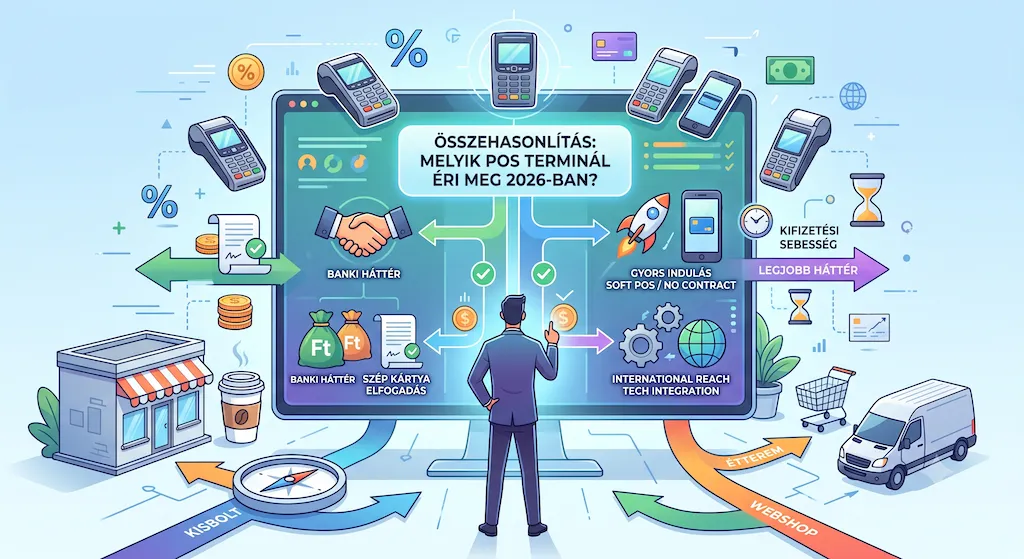
(The picture is for illustration only!)
Weekly summary of the best POS terminal offers
We handle your data confidentially. Details in the privacy policy.