
- Offers
- Service providers
- Knowledge base
- Tools
- Arena
- Contact
- Partners
EN
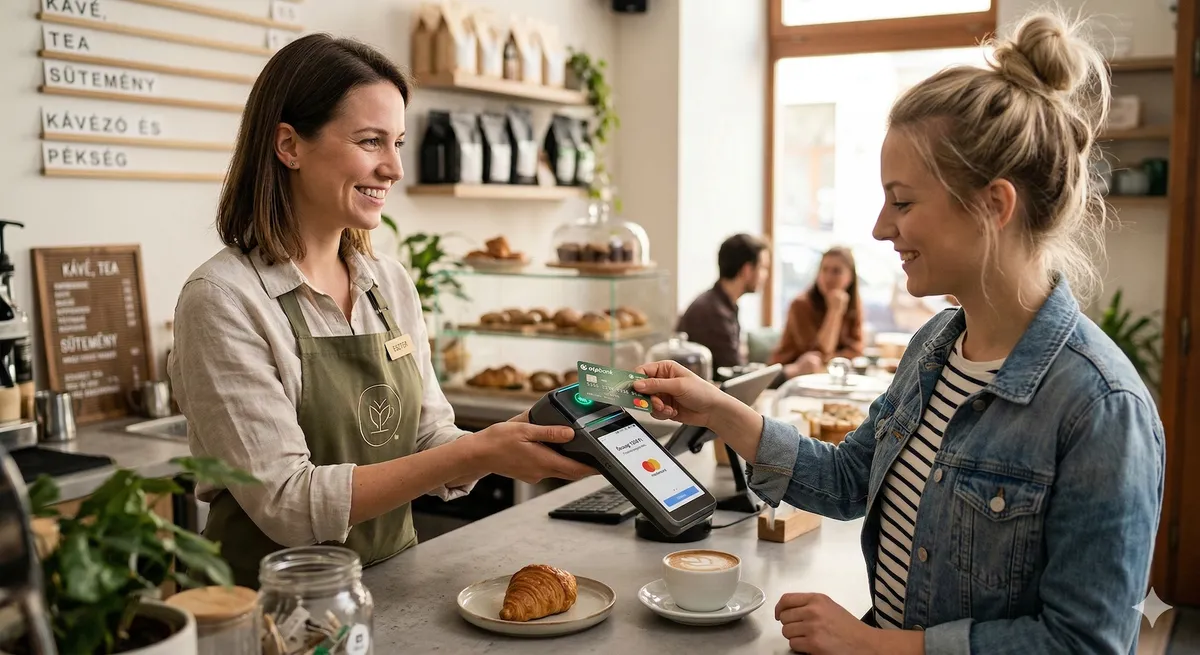
If you're starting a business in Hungary or already running one, you'll inevitably face the question: how do I accept card payments? The answer is almost always a POS terminal — but what exactly is it, why do you need one, and how do you choose the right one? This guide covers everything you need to know as a merchant.
A POS terminal (Point of Sale terminal) is an electronic device that enables your business to accept debit and credit card payments. When a customer taps or inserts their card, the terminal communicates with the bank, processes the transaction, and completes the payment within seconds.
The card terminal — as many call it — is the small device you see at the checkout counter, with a waiter at a restaurant, or with a delivery driver. But modern POS terminals can do much more: they handle contactless payments, Apple Pay, Google Pay, and even QR code payments.
The payment process is surprisingly fast, but several steps happen behind the scenes:
The customer taps, inserts, or swipes their card on the terminal (contactless, chip, or magnetic stripe payment).
The terminal sends the encrypted data through the payment network (e.g., Visa, Mastercard) to the card-issuing bank.
The bank verifies the transaction: Is there sufficient funds? Is the card valid? Is the purchase suspicious?
Approval or decline comes back — all within 2-5 seconds.
The money arrives in your merchant account, typically within 1-2 business days.
The entire process is coordinated by the acquiring bank and your payment service provider. As a merchant, you deal directly with the payment provider — they supply the terminal and the back-end system.
Not every terminal suits every business. The choice depends on whether you sell in a shop, at a market, in a restaurant, or online.
Operates via a wired internet connection, typically stationed at the checkout. Stable, fast, and used in most retail shops. Ideal if you always accept payments at the same location.
Operates via WiFi or mobile data (SIM card), making it usable both inside and outside the premises. Perfect for restaurants where the waiter brings the terminal to the table, or for market vendors and businesses at events.
The newest solution: with SoftPOS technology, your smartphone becomes a POS terminal. Using an app, you can accept contactless card payments directly on your NFC-enabled phone — no extra hardware needed. This is the cheapest entry point into card acceptance and is particularly popular among sole traders and small businesses.
A smart cash register that combines payment acceptance, inventory management, invoicing, and sales analytics. Ideal for larger shops and restaurants that need a comprehensive system.
The real question is: can you afford not to have one? Hungarian consumers increasingly pay by card — according to MNB data, more than half of retail payments in 2025 were made by card. If you don't accept card payments, you're losing customers.
It's important to know that in Hungary, providing electronic payment options has been a legal requirement since January 1, 2021. Section 5/F of Act CLXIV of 2005 on Trade stipulates that every merchant who fulfills their receipt-issuing obligation using an online cash register must provide consumers with an electronic payment option and ensure its continuous availability.
In practice, this means that if you use an online cash register (mandatory for most commercial activities), you must offer some form of electronic payment — typically card payment via POS terminal, SoftPOS, or another solution. The regulation does not specify which type of electronic payment you must accept, but you must offer at least one.
The specific scope of affected merchants is detailed in NGM Decree 48/2013 (XI. 15.). Non-compliance may result in consumer protection fines.
Higher revenue: Research shows that customers paying by card spend on average 20-30% more than cash payers.
Less cash handling: No need to make change, no bank deposits, lower theft risk.
Faster payments: Contactless payments take seconds — shorter queues, happier customers.
Professional image: Card acceptance is a basic expectation in 2026 — customer trust increases when they see you offer modern payment methods.
Transparent finances: Every transaction is traceable, simplifying bookkeeping and tax reporting.
POS terminal costs consist of several fee components. It's important to look at the total monthly cost, not just the device price.
Terminal rental fee: HUF 2,000 – 8,000 per month for traditional terminals. SoftPOS solutions often have no monthly fee.
Transaction fee: 0.8% – 2.5% of each transaction, depending on the provider. Most providers charge around 1-1.8%.
One-time costs: Installation fee (HUF 0 – 30,000), possibly a deposit for the device.
Minimum turnover fee: Some providers charge a fixed fee if you don't reach the minimum monthly transaction volume.
Exact costs depend on the industry, monthly turnover, and chosen provider. With the POSnavigator.eu calculator, you can find the best offer in minutes — based on real, up-to-date fee data.
Choosing a terminal isn't just about finding the cheapest option. Consider the following factors:
Where do you accept payments? Fixed location (shop) → countertop terminal. Multiple locations (market, events, table service) → portable. Occasional use → SoftPOS.
What's your monthly card turnover? High turnover → lower transaction fees matter more. Low turnover → a solution with no monthly fee may be better.
Which cards do you need to accept? Most terminals handle Visa and Mastercard. If you have international guests, check whether Amex and UnionPay are also supported.
Contract terms: Watch for contract length (any lock-in?), cancellation conditions, and hidden fees.
Customer support: When issues arise, you need quick solutions — it's worth choosing a provider with accessible, local-language support.
In Hungary, dozens of payment service providers offer POS terminals. The main categories:
Bank providers: OTP, Erste, MBH, Raiffeisen, and other banks offer their own POS services. The advantage is integration with your existing bank account; the disadvantage is often longer contract lock-in and less flexible terms.
Independent payment providers: SumUp, myPOS, Teya, and similar companies typically offer more flexible terms, faster onboarding, and more transparent pricing.
Online payment providers: If you run a webshop, Barion, SimplePay, or Stripe provide online payment gateway services.
Hard to compare all the offers? POSnavigator.eu is built for exactly this: compare providers, review their fees, and find the best solution for your business.
In short: as soon as possible. Card acceptance is especially important if:
You have a physical shop or service where customers visit.
You run a restaurant or café — more and more customers tip by card too.
You sell at markets, fairs, or events — a mobile terminal or SoftPOS handles this.
You provide services (hairdresser, massage therapist, repair shop) — customers expect card payment.
You run a webshop — without online card payment, cart abandonment rates skyrocket.
A POS terminal is no longer a luxury but an essential business tool — and providing electronic payment options is even a legal obligation in Hungary. Whether it's a traditional card terminal, a portable device, or a SoftPOS solution — card acceptance increases your revenue, improves the customer experience, and makes your business more professional.
To make the right choice, compare providers and their fees. POSnavigator.eu helps with exactly that: based on real data, it shows you the best solution for your business.
Weekly summary of the best POS terminal offers
We handle your data confidentially. Details in the privacy policy.