
- Offers
- Service providers
- Knowledge base
- Tools
- Arena
- Contact
- Partners
EN
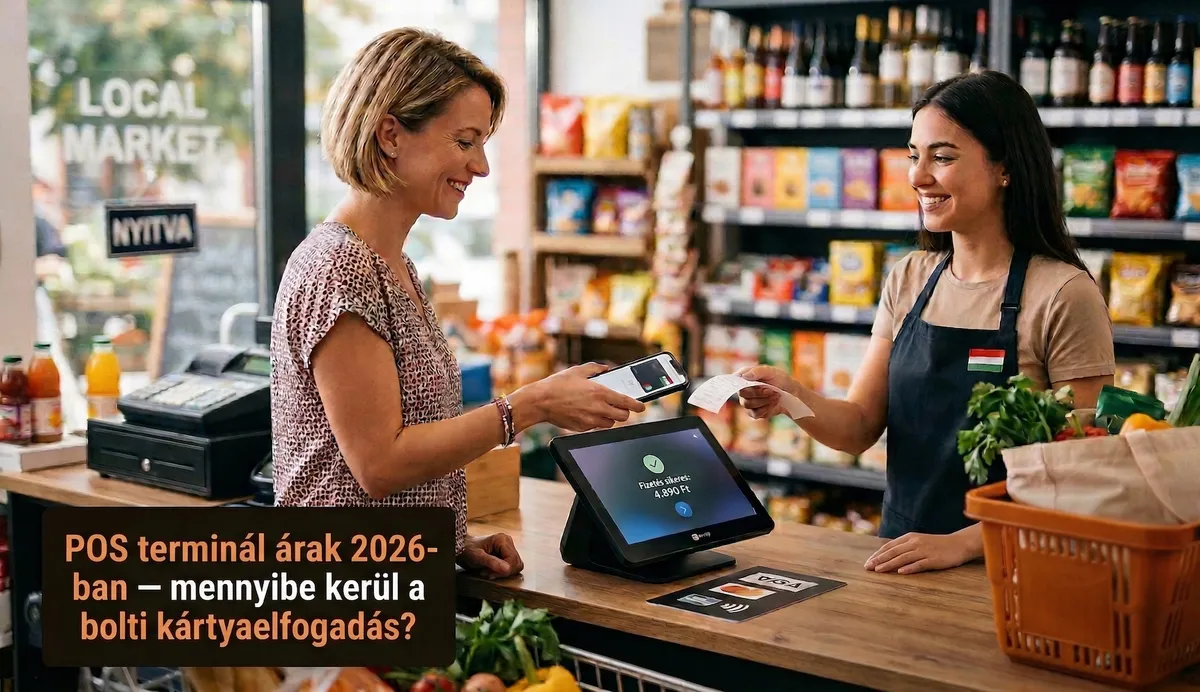
When looking for a POS terminal for your business in Hungary, the first question is almost always about price. But the cost of card acceptance isn't a single number — it's a combination of several fee components that vary by provider.
In this article, we focus on the costs of physical, in-store card acceptance: using POS terminals and SoftPOS solutions. We cover online payment gateways (for webshops), unattended POS solutions (for vending machines), and alternative payment methods (such as QR-based or Qvik) in separate articles.
For a more specific calculation: you can also start from dedicated pages for small-shop POS terminals, restaurant and cafe POS solutions, or phone-based SoftPOS acceptance.
The total cost of in-store card acceptance typically consists of four main elements, depending on the pricing model:
Terminal fee: A monthly rental fee (if the provider supplies the device) or a one-time purchase price. Rental fees typically range from HUF 0–5,000/month, while purchasing costs HUF 10,000–120,000 depending on the device type. With SoftPOS, hardware costs are typically lower or zero.
Transaction fee (merchant service charge): A fee charged on every card payment, usually a percentage of the transaction amount. In Hungary, this typically ranges from 0.75% to 1.95%, though the structure varies by provider.
Interchange fee: Paid to the card-issuing bank. Regulated in the EU: maximum 0.2% for consumer debit cards and 0.3% for credit cards. Important: this cap only applies to EU-issued consumer cards. For non-EU (foreign) cards and corporate (commercial) cards, the interchange fee is significantly higher — it can reach 1.5–2.0%. For businesses in tourist areas or serving corporate clients, this noticeably increases the average transaction cost.
Card scheme fee: A system fee from Visa and Mastercard, typically 0.03–0.15%. This isn't uniform either: cross-border and premium card transactions carry higher scheme fees.
Before looking at individual providers, it's important to understand the two main pricing models, as they determine your final cost:
Interchange++ (cost-plus) pricing: The provider passes through the interchange fee and card scheme fee (both variable), then adds a fixed merchant fee on top. This is the more transparent model — you can see what each component costs. However, your monthly cost varies by card type — if you accept many foreign tourist or corporate cards, the actual fee will be higher.
Flat rate (blended) pricing: The provider charges a fixed percentage regardless of card type. Simpler to calculate, but not necessarily cheaper. The flat rate includes an average of all interchange fees — if most of your customers pay with domestic debit cards, you're likely paying more than you would under interchange++ pricing.
Some providers publish their pricing openly — making comparison easier. Others require a custom quote, which may actually result in a better deal because the price is tailored to your volume. Open pricing offers simplicity; custom pricing offers optimization.
Below we present every provider in the POSnavigator database that offers physical card acceptance solutions in Hungary.
Traditional banks typically use interchange++ pricing models, but the pricing is customized: the merchant fee depends on the business's turnover, sector, and accepted card types. You rent the terminal (not buy), and the bank provides the complete infrastructure.
OTP Bank — Hungary's largest bank with the most extensive POS terminal network. Merchant commission is interchange++ based. Monthly fee is customized, typically HUF 0–5,000/month. Installation, communication, and maintenance are free. Strengths: SZÉP card acceptance, installment payments, DCC (dynamic currency conversion), qvik, tip handling. Through the OTP Group's SimplePay, SoftPOS and online payment solutions are also available.
K&H — interchange++ pricing with custom quotes. K&H offers SoftPOS alongside traditional POS terminals. Pricing is not public.
CIB Bank — POS terminal and SoftPOS service with unique pricing, based on interchange++. CIB is particularly strong in the SME segment.
MBH Bank — POS terminal service available through custom quotes. Interchange++ pricing.
Unicredit — strong in the corporate segment, offering POS terminal services with interchange++ pricing and custom rates, potentially favorable for higher-volume merchants.
Raiffeisen Bank — offers card acceptance as a standalone payment solution brand (Raiffeisen Payment Solutions). Depending on the size of the business, it offers advertised pricing or individual pricing in the interchange++ model.
One — present with both POS terminal and SoftPOS services. Custom pricing, interchange++ model.
These providers publish their fees openly — no custom quote needed. Terminals are typically purchased (not rented), but there's no monthly fee and no contract commitment.
SumUp — is the easiest entry point. Merchants can choose from two packages: Flat 1.95% transaction fee, no monthly fee or 0.95% transaction fee with monthly fee, no loyalty period. You have to buy the terminal: the SumUp card reader starts at approx. 15,000 HUF, the standalone Solo terminal is available for approx. 58,000 HUF and there are several promotions. SoftPOS (Tap to Pay) is also available for the same fee. Advantage: immediate start, no paperwork, lower turnover, for small businesses starting out, it may be an advantage to only pay a fee if there is turnover. Disadvantage: the flat 1.95% fee can be more expensive than interchange++ pricing for higher turnover.
myPOS — also a no-monthly-fee model with lower flat transaction fees: 1.20–1.75% depending on card type and plan. Terminal must be purchased. You receive your own myPOS merchant account with instant fund access. Downside: transferring from myPOS to a bank account may incur fees. myPOS also offers unattended POS solutions for vending machines — covered in a separate article.
viva.com — a European fintech provider using interchange++ pricing that's publicly available on their website. This is a rare combination: transparent interchange++ rates without contract commitment.
These providers combine fintech flexibility with the bank-style interchange++ pricing model. Pricing is custom, based on volume and requirements.
Teya — a European provider growing rapidly in Hungary. Interchange++ pricing, modern terminals, and extensive supplementary services (accounting integration, digital loyalty programs, website building, hospitality software). Custom pricing that can be favorable depending on volume.
Novopayment — Hungarian-founded, bank-independent provider with interchange++ pricing. Typically focuses on the SME segment with custom quotes based on turnover.
4SPEND — newer market entrant with interchange++ pricing. Custom quote required.
Agora Pay — bank-independent provider with interchange++ model. Pricing structure overview available on their website.
BIZPAY — bank-independent provider operating on Worldline technology infrastructure. Interchange++ pricing with custom quotes.
Fizetési Pont (OFSZ) — a long-established provider in the Hungarian market, primarily targeting small businesses. Custom pricing, but pay close attention to contract terms — Fizetési Pont contracts tend to be long-term (3–5 years), and the service may be tied to an account agreement.
Paynance — fintech provider offering card acceptance solutions in Hungary.
Some providers don't sell directly to merchants but rather power the acceptance infrastructure behind other banks and fintech companies:
Global Payments — international payment processor providing transaction processing and technology infrastructure behind multiple Hungarian banks and providers.
Worldline — another international infrastructure provider, also present in Hungary with SoftPOS (Tap on Mobile) solutions. BIZPAY, for example, runs on Worldline technology.
The following providers primarily offer online payment solutions, but some also enable physical card acceptance (e.g., via SoftPOS or payment links). We cover these in detail in a separate online payments comparison article.
Barion — one of Hungary's most popular online payment gateways, but also usable for physical acceptance via SoftPOS and payment links. SimplePay — OTP Group's online payment system, which also offers POS terminals (through OTP Bank infrastructure). PayU — international online payment gateway available in Hungary. PayPal — global online payment platform. Billingo — primarily an invoicing platform, but also offers payment link solutions. Mollie — Dutch fintech offering omnichannel (online + in-store) solutions. Revolut — Revolut Business also offers payment acceptance services, with publicly available pricing on their website.
Nayax — specialized in unattended payment solutions: vending machines, parking systems, self-service kiosks. We cover this in a dedicated article.
Several providers above offer SoftPOS alongside physical POS terminals. With SoftPOS, your phone (Android or iPhone) becomes the card reader — no separate hardware needed. This means lower entry costs, though transaction fees are typically the same or similar to traditional terminals.
SoftPOS is particularly practical for couriers, market vendors, service providers, or businesses that only occasionally accept card payments. We present a detailed SoftPOS comparison and head-to-head with traditional terminals in a separate article.
The choice primarily depends on your monthly card turnover and your customer card mix:
Low volume (HUF 0–300,000 monthly card turnover): No-monthly-fee providers are the simplest starting point. The higher transaction fee is not a significant amount, in return there is no monthly fee, no commitment.
Medium volume (HUF 300,000–2,000,000): Worth requesting bank and interchange++ quotes. If most customers pay with domestic debit cards, interchange++ pricing is typically lower than flat rates.
High volume (over HUF 2,000,000 monthly): Bank-based interchange++ pricing is clearly more favorable. The uniform fee means a difference of several hundred thousand on an annual basis compared to the interchange++ model at high traffic volumes.
Many foreign tourists or corporate card customers: If this describes your customer base, flat rate pricing may actually be better, because foreign and corporate card interchange fees are significantly higher (up to 1.5–2.0%), which you'd pay under interchange++ pricing. With flat rates, the provider has already averaged these into the price.
The comparison above provides a general picture, but exact costs depend on your situation: your turnover, what types of cards your customers use, how many terminals you need, and what additional features you require.
With the POSnavigator.eu comparison tool, you can instantly compare costs for providers with open pricing. For custom-priced providers, POSnavigator helps you understand the market landscape so you can request quotes with confidence.
The cost of in-store card acceptance is not a single fee, but the sum of terminal fees, transaction commissions, interchange fees, and card scheme fees. The key takeaway: don't just look at the monthly fee — consider the total monthly cost relative to your turnover, and pay attention to card type effects (foreign and corporate cards are more expensive).
Providers with open pricing (e.g. SumUp, myPOS, viva.com) make comparison easier, but bank and fintech providers with custom quotes (e.g. OTP, K&H, Teya, Novopayment) may offer better rates tailored to your volume. Always run the detailed comparison based on your own numbers.
Weekly summary of the best POS terminal offers
We handle your data confidentially. Details in the privacy policy.