
- Offers
- Service providers
- Knowledge base
- Tools
- Arena
- Contact
- Partners
EN
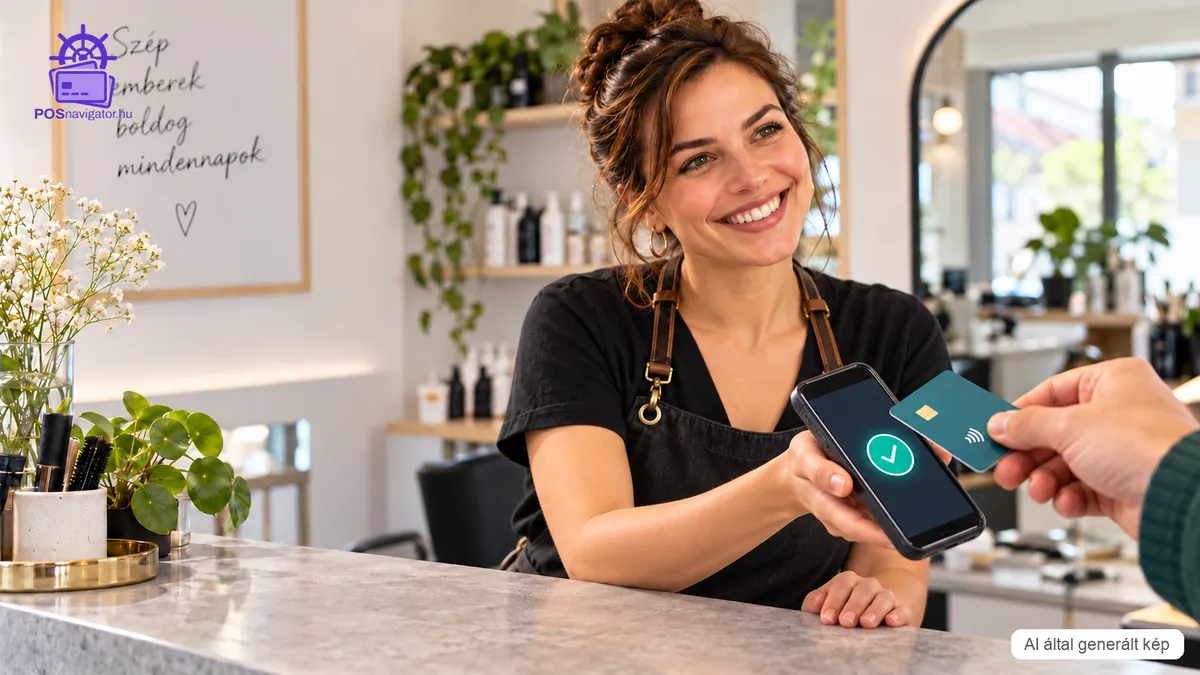
Picture this: the colour is done, the client is happy, and now she wants to pay — but she has not brought enough cash. You also do not want another bulky terminal, charger and extra admin process on a clean salon counter. So the practical question is simple: can you accept cards on your phone, or does your salon need a separate POS terminal?
There is no single right answer for beauty businesses. A solo hairdresser, a mobile beautician, a three-chair barber shop and a larger salon all work differently. At POSnavigator, we start from the merchant's workflow: how your clients pay, your average transaction value, whether tips matter, and how much equipment you want on the counter.
In hair and beauty services, payment usually happens after an appointment, not in a checkout queue. The client is often a returning customer, the ticket size may be higher than in quick retail, and the service is personal. That means it is not enough that SoftPOS works technically. It also has to feel natural in the salon.
On a clean nail or beauty counter, it matters whether you add another device, or simply take your phone, enter the amount and let the client tap. On the other hand, if you process many transactions a day, several colleagues use the same payment point, or clients often ask for paper proof, a separate card reader or classic POS terminal can be easier.
SoftPOS means that a compatible phone accepts contactless cards or wallets through a payment app. The client taps a Visa or Mastercard card, or uses Apple Pay or Google Pay.
This is a strong option if you work alone, want fewer devices, and do not want to start with a fixed terminal rental. For a hairdresser or beautician, the phone is already used for bookings, photos and messages — accepting payments on it can be a natural extension.
The real question is not whether taking payments on a phone is modern. The real question is whether reception is stable in the salon, whether your device is supported, whether the battery lasts all day, and how the app confirms a successful payment.
A mobile card reader is a good middle ground. It is less of a commitment than a classic terminal, but still gives clients a dedicated payment device. Consider it if you do not want clients tapping your own phone, if several colleagues use the same payment solution, or if a separate device simply feels more comfortable.
In a salon, this is often about psychology: the client sees a payment device, taps, and the moment is finished.
If you run several chairs, multiple staff members, a reception desk or higher daily volume, a classic POS terminal can still be the better workflow. It is familiar, stable, and often easier for shared use, paper receipts or cash-register integrations.
Choose a terminal not because it looks more serious, but because your daily operation needs it: several clients, several staff members, reception-based payments, frequent paper requests, or a process where not everything should run on your personal phone.
Payment and receipt issuance must be separated. When the phone says the payment was successful, that is payment confirmation. It does not automatically solve your receipt and tax reporting workflow.
This is especially important in 2026. According to NAV, from 1 September 2026 the general receipt data reporting obligation applies to manual and computer-generated receipts as well. Check NAV's official information on e-cash-register use and receipt data reporting. If you are unsure which cash-register or receipt rules apply to your business, your accountant remains the safe reference point.
POSnavigator focuses on the payment market. We can help you avoid mixing up card acceptance with receipt compliance. The two can be integrated, but not every SoftPOS app does that automatically.
If you work alone: as a hairdresser, beautician, nail technician or massage therapist, SoftPOS may be the lowest-friction entry point.
If counter space is limited: a phone-based flow is cleaner than one more device, cable and paper roll.
If monthly revenue varies: fixed terminal fees can hurt when the business is seasonal or appointment volume fluctuates.
If you also work on location: phone-based acceptance means one less device to carry.
Still, test the everyday details: does the phone work in its case, how easy is amount entry, and what happens if the client asks for printed proof?
If several people work in the salon: payments should not depend on one person's phone.
If you have reception or a shared checkout: a fixed payment point is easier to manage.
If transaction volume is high: a separate device can be faster and less disruptive.
If tips matter: ask how the provider handles tips and how they appear in settlement.
If e-cash-register or cash-register integration is needed: look beyond the card fee and check the full daily workflow.
The cheapest-looking offer can become expensive if it does not fit your workflow. For beauty service providers, ask about:
monthly fee or device rental;
transaction fee for domestic consumer cards;
different fees for business, foreign or credit cards;
whether a provider bank account is required;
settlement time;
contract length or minimum turnover;
refunds, cancellations and disputed transactions;
integration with invoicing, receipt apps or e-cash-register tools.
Electronic payment is no longer a special extra. The MNB has long highlighted that merchants with online cash registers must provide electronic payment options, while qvik can be an additional alternative next to cards. The MNB's qvik information for businesses is here: qvik for businesses. For most beauty businesses, however, clients' familiar card and wallet payments remain a basic expectation.
We have created a page on POSnavigator where we recommend solutions based on a profile typical of beauty industry service providers. Profile details: hair and beauty MCC, in-person payment channel, SoftPOS and POS terminal solution types, with an example calculation of HUF 800,000 monthly card turnover and HUF 12,000 average transaction value. This is only a starting point. The point of the landing is to give salons a relevant preset that can be adjusted with their own numbers.For many solo providers, yes — especially if they want fewer devices and do not need a shared checkout. For multiple staff members or higher daily volume, a separate card reader or POS terminal may be more convenient.
No. SoftPOS handles the payment. Receipt issuance and NAV reporting are separate compliance questions that require an e-cash-register, receipt app or integrated solution.
A payment confirmation and a tax receipt are not the same. If clients ask for paper, or your operation requires it, check how printing works and what extra device is needed.
It depends on turnover, average transaction value, card mix, bank account requirements and device needs. Do not decide based on one percentage only: compare monthly fees, transaction fees, device costs and settlement conditions together.
In beauty services, payment is the final impression. If it is smooth, modern and calm, it strengthens trust. If it becomes a search for signal, double entry or confusion, it creates friction right after a well-delivered service.
That is why it is worth deciding in advance whether a phone, card reader or POS terminal fits your daily workflow best. On POSnavigator you do not have to guess: you can compare options based on your own turnover and practical needs.
Weekly summary of the best POS terminal offers
We handle your data confidentially. Details in the privacy policy.