
- Offers
- Service providers
- Knowledge base
- Tools
- Arena
- Contact
- Partners
EN
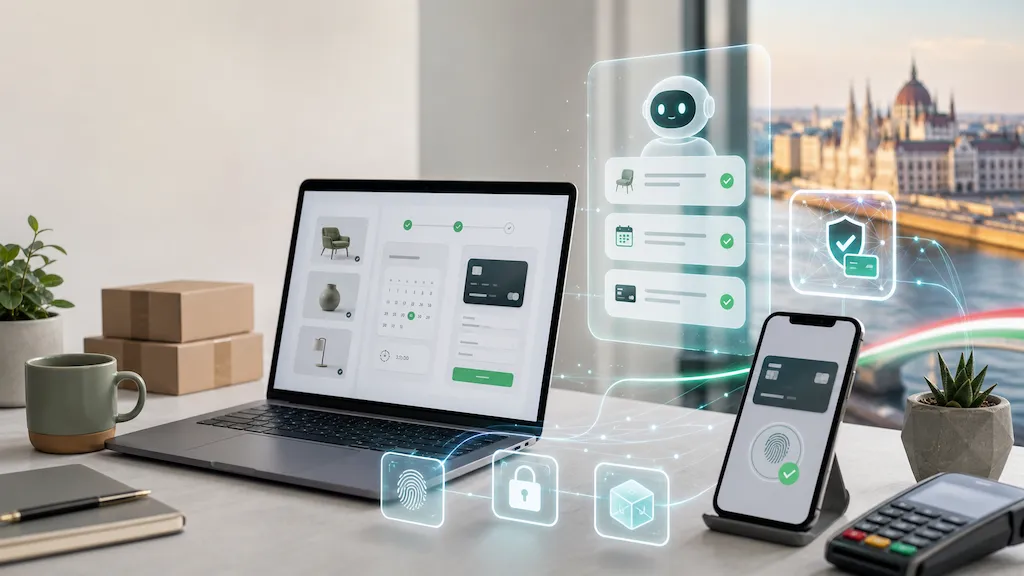
AI-agent payments are no longer a distant fintech concept in Hungary. On 5 May 2026, Mastercard and OTP Bank announced Hungary's first live, authenticated payment initiated by an AI agent. According to FinTechZone, the agent selected a coffee tasting, booked a time slot and paid a deposit with an OTP-issued Mastercard on Priceless.com. Two weeks later, SimplePay and FinTechZone dedicated a webinar to how AI will reshape online shopping and payment experiences.
For Hungarian merchants, this is not mainly a story about “robots paying instead of people”. It is a checkout, trust and discoverability question. If an AI assistant searches, compares, books and initiates payment on behalf of a customer, the merchant must be ready for both human shoppers and machine-readable buying journeys. Research date: 23 May 2026.
The Hungarian milestone matters for three reasons. It was a live authenticated transaction, not only a lab demo. It happened in a consumer shopping context, not only in internal banking automation. And human control did not disappear: the AI agent prepared the transaction, while customer authorisation and strong customer authentication remained central.
The international market is moving quickly. Mastercard Agent Pay treats AI agents as registered, recognisable participants using agentic tokens, verifiable intent and biometric approval. Visa, Stripe/OpenAI and Google are also building agentic commerce and payment standards. The practical conclusion for merchants is simple: when choosing a payment provider, AI-readiness is becoming part of the decision.
It is a buying flow where an AI assistant does more than provide information. It may search, filter offers, assemble a cart, book a service and initiate or prepare payment on behalf of the customer. In a safe model, this is not an unlimited mandate. The customer defines rules, limits, purpose or approval points, and the payment is tokenised and auditable.
That is why serious payment schemes focus on agent identity, user intent, scoped tokens and strong authentication. The goal is not to expose card data to a chatbot. The goal is to let the ecosystem recognise who or what initiated the payment, what the customer authorised and within what limits.
The first impact will be traffic and conversion, not payment fees. Today, merchants optimise for Google, price comparison sites, social media and marketplaces. In an AI-agent world, the customer may ask an assistant to find a reliable Hungarian shop with same-day pickup, book an appointment, reorder a product or choose the best-value provider. In that journey, the AI also evaluates the merchant.
That can introduce new ranking factors: accurate stock, machine-readable prices, shipping and refund rules, clear terms, stable checkout, fast payment methods, low failure rates and transparent support. A slow or unclear payment flow can become a competitive disadvantage, just as a poor mobile checkout is today.
If you are selecting an online gateway, see POSnavigator's guide: Payment gateway for your webshop. AI-agent payment will initially sit on top of existing gateway, tokenisation, strong authentication and checkout infrastructure.
Agentic payments will first matter in e-commerce, bookings, ticketing, deposits, subscriptions and repeat purchases. If your payment page is weak on mobile, fails during 3DS authentication, or handles redirects poorly, fix that first. Embedded payment, saved payment methods and stable return flows already improve conversion today.
Mastercard Click to Pay, digital wallets and one-click payments reduce manual card entry. That matters even more when AI is involved: the future is not agents copying card numbers, but authenticated, tokenised and traceable payment flows.
You do not need to build your own agentic payment protocol. But you should ask whether your PSP plans to support Mastercard Agent Pay, Visa AI commerce, Stripe/OpenAI ACP, Google AP2 or similar standards; how it handles tokenisation; what merchant data will show that a transaction was agent-initiated; and how chargebacks and fraud rules will work.
AI agents need clear data: prices, stock, shipping, returns, payment methods, booking rules and customer support. If key information only exists in images, PDFs or vague marketing copy, future AI shoppers may struggle to trust or select your business.
If an agent misunderstands a request, everyone will need evidence. What did the customer authorise? What cart was approved? What limit applied? What terms were visible? Agentic payments are therefore not only a checkout issue, but also a documentation and customer support issue.
In Hungary, agentic payments should not only be seen through card rails. qvik instant payment is a domestic instant-payment-based solution supported by the MNB. The visible AI-agent story currently moves fastest through international card networks, but merchants should watch how AI assistants may later interact with payment requests, links, QR or instant-payment flows.
No. The first impact is online: webshops, bookings, ticketing, deposits and digital checkout. Physical POS and SoftPOS remain crucial for face-to-face commerce. But even physical merchants should keep product, opening-hour, availability and pickup information clean, because AI assistants may influence store discovery before the customer arrives.
POSnavigator helps Hungarian merchants compare payment providers based on their own channels, volume and cost structure, instead of choosing only by trend or brand name.
No. The May 2026 Hungarian transaction is an important live market signal, not mass availability. Rollout will depend on banks, PSPs, schemes and commerce platforms.
In a safe model, not without limits. The AI may search, prepare and initiate, but user intent, limits and approval must be recorded. The Hungarian example highlighted customer authorisation and biometric strong customer authentication.
Ask which agentic payment standards it follows, how it handles tokenisation, what merchant-side transaction data will be available, and how fraud and chargeback handling may change.
Not in the short term. Agentic payments first affect online commerce, bookings, deposits and digital checkout. POS and SoftPOS remain important for in-person payments.
Improve mobile checkout quality, tokenised payment support, structured product data and refund documentation. These steps help conversion today and AI-readiness tomorrow.
Weekly summary of the best POS terminal offers
We handle your data confidentially. Details in the privacy policy.